


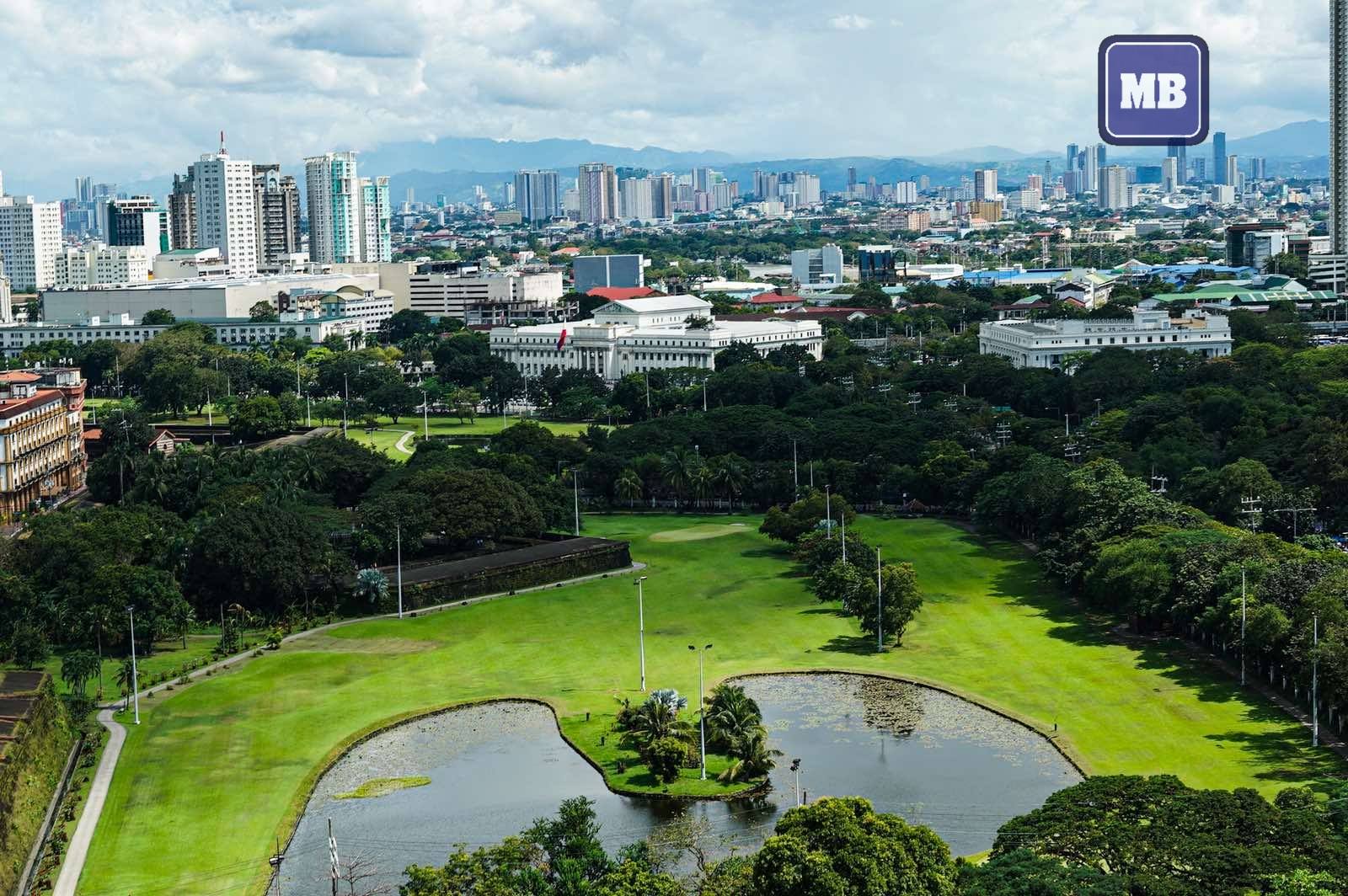
When a Sunday Stroll Becomes a History Lesson: The Sacred Ground of Intramuros
My old campaign buddy Gibet Buenaventura posted photos on Facebook the other day. His selfie with a background of lush verdant open space beneath a baby blue sky, the kind of place that makes you think “where is this gorgeous spot and when can I visit?”
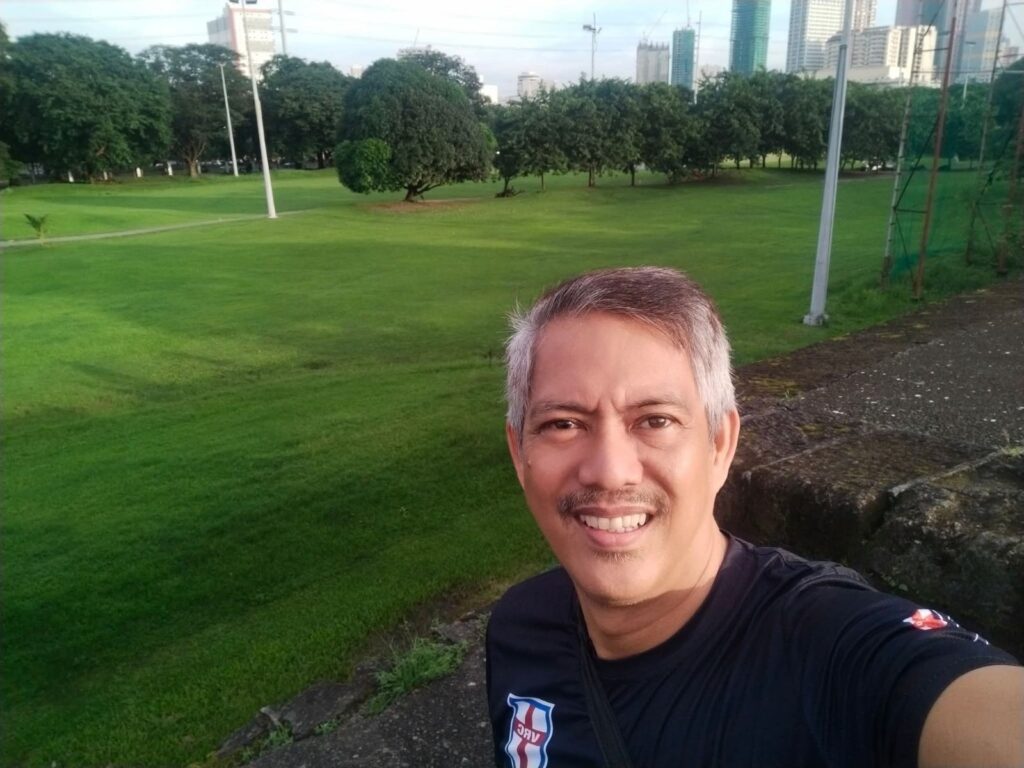
Gibet Buenaventura, an old friend from my campaign days. He is an avid dragon boat guy and advocate of many causes.
So I asked him: “Where is this?”
“Intramuros,” he said. “They opened it up. You can walk there on Sundays now.”
Intramuros. Our Intramuros. The one that’s been sitting in the middle of Manila this whole time.
The Pattern: Manila Discovers Walking
If you’ve been paying attention, you’ll notice Metro Manila’s component cities have suddenly discovered that people like walking places without dodging cars. Makati’s been doing it forever with their Sunday streets. Quezon City jumped in with Timog. Manila opened up Roxas Boulevard.
Now it’s Intramuros’ turn.
And honestly? The announcement was about as low-key as it gets. I just stumbled across a Manila Bulletin Facebook post: “The Tourism Infrastructure and Enterprise Zone Authority (TIEZA) has announced that starting Nov. 26, the golf course will open as a community recreational space every Sunday to promote family bonding and encourage quality time together.”
A golf course opening for “family bonding.” That’s how they’re selling it.
Turns out Gibet was ahead of the official announcement—he’d already been there, already captured those photos. Classic insider move.
A Memory from the WOW Philippines Days
This actually reminded me of the early 2000s when I was working with then-Tourism Secretary Richard Gordon. He had this vision to transform part of Intramuros into the venue for WOW Philippines—bringing together the best of all 14 Philippine regions in one running showcase. It was ambitious, it was loud, it was very Gordon.
Not since then has Intramuros gotten this kind of attention or promotion. Which makes this quiet little TIEZA announcement even more interesting.
But Here’s What Most Filipinos Don’t Know
When you walk those paths on Sunday—those beautiful, tree-lined paths that made me ask Gibet where this magical place was—you’re walking on sacred ground. And I don’t mean that metaphorically.
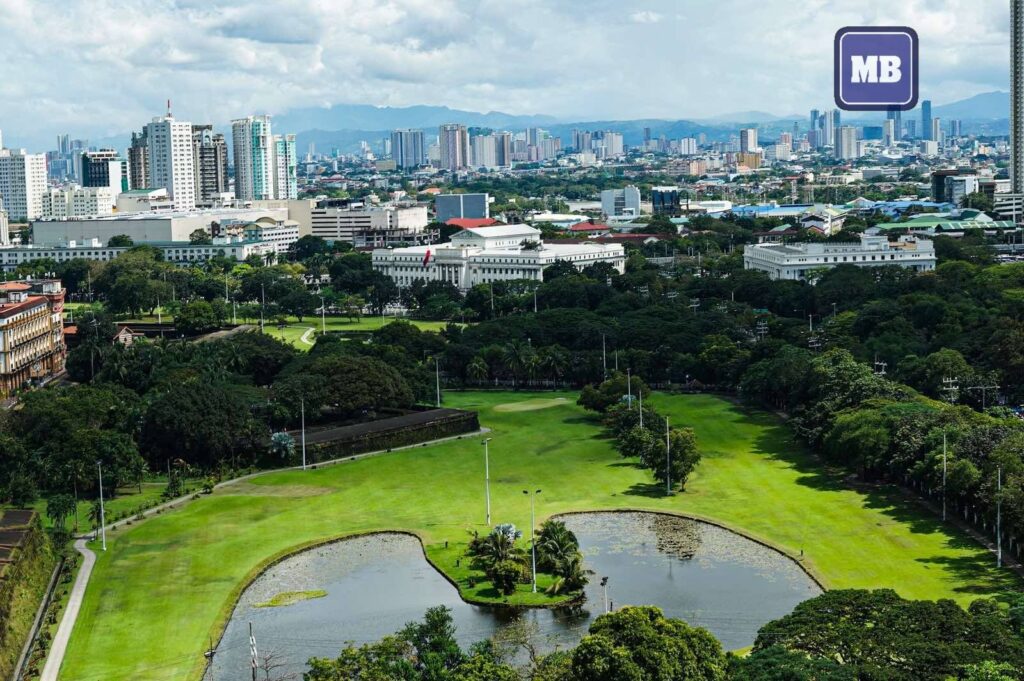
Photo from Manila Bulletin posted on their Facebook page. The photo was probably taken from the vantage point along the wall overlooking part of the golf course.
You’re walking over the site of one of World War II’s most devastating urban battles. A battle that shouldn’t have happened. A battle that killed over 100,000 Filipino civilians in just one month. A battle that erased nearly 400 years of irreplaceable architectural and cultural heritage.
Let me tell you the story most of us never learned properly.
The Admiral Who Defied Orders
The Battle of Manila was never supposed to happen. General Tomoyuki Yamashita, the Japanese Army’s supreme commander in the Philippines, had ordered a full withdrawal from the city. His logic was sound: he couldn’t feed Manila’s one million residents, and defending a city full of wooden buildings was impossible. Better to fight a war of attrition in the northern Luzon mountains.
But Rear Admiral Sanji Iwabuchi decided to ignore those orders.
This wasn’t just one man’s insubordination—it revealed a fatal crack in the Japanese command structure. The naval staff in Japan backed Iwabuchi’s decision, completely undermining Yamashita’s strategy. With 12,500 sailors and marines plus 4,500 army personnel, Iwabuchi was determined to fight to the death.
Some historians believe he was motivated by shame from losing his previous command, the battleship Kirishima. Before the battle, he told his men: “We are very glad and grateful for the opportunity of being able to serve our country in this epic battle. Now, with what strength remains, we will daringly engage the enemy. Banzai to the Emperor! We are determined to fight to the last man.”
One man’s defiance sealed an entire city’s fate.
The City That Connected Three Continents
What Iwabuchi condemned wasn’t just any city. For 250 years—from 1565 to 1815—Manila was the hub of the Manila-Acapulco Galleon Trade, one of the world’s first truly global trade networks. It directly connected Asia with the Americas and, through them, with Europe.
Once or twice a year, massive galleons would make the brutal Pacific crossing. The eastward journey from Manila to Acapulco took six months, with crew mortality sometimes hitting 50%. The westward return took a comparatively easy three to four months.
These weren’t just any ships. They were “the largest class of European ships known to have been built until then,” constructed in Philippine shipyards like Cavite from local hardwoods, crewed predominantly by Filipino natives. They carried Chinese silk, porcelain, and spices to exchange for New World silver that Ming China desperately wanted.
For 250 years, Manila wasn’t just a regional capital—it was a cornerstone of global commerce.
The Month That Changed Everything
The battle lasted from February 3 to March 3, 1945. Military historians call it “the worst urban fighting fought by American forces in the Pacific theater” and “the single largest urban battle ever fought by American forces.” They nicknamed it “the Stalingrad of Asia.”
The numbers tell part of the story: 1,010 American soldiers killed, at least 16,000 Japanese defenders killed. But those numbers are dwarfed by the civilian toll: over 100,000 Filipino non-combatants perished.
The destruction came from two sources, and this is where it gets complicated.
Japanese forces, knowing they were doomed, unleashed the Manila Massacre—systematic atrocities including mutilations, rapes, and mass executions in hospitals, schools, and convents. They used women and children as human shields.
But the Americans contributed to the destruction too, though for different reasons. General MacArthur initially forbade artillery and air strikes to spare the city. But facing intense resistance that was killing his soldiers, he reversed that order on February 9th.
The result? Massive artillery barrages that pulverized entire buildings, killing Japanese defenders and the civilians trapped inside with them. Army Historian Robert R. Smith wrote about the decision to raze Intramuros: “Just how civilian lives could be saved by this type of preparation, as opposed to aerial bombardment, is unknown. The net result would be the same: Intramuros would be practically razed.”
He concluded: “That the artillery had almost razed the ancient Walled City could not be helped. To the XIV Corps and the 37th Division at this state of the battle for Manila, American lives were understandably far more valuable than historic landmarks.”
What We Lost
In one month, nearly 400 years of architecture, art, and history were wiped out. The historic core of Intramuros was almost completely destroyed. Countless government buildings, ancient universities, convents, monasteries, and churches were ruined. In the business district, only two buildings remained undamaged.
This wasn’t just property damage. It was the erasure of physical evidence of Manila’s unique identity as a “confluence of Spanish, American and Asian cultures.” After the war, most damaged structures weren’t restored—they were demolished for modern buildings. With few exceptions, the architectural soul of the old “Pearl of the Orient” vanished forever.
Walking on Sacred Ground
There’s a memorial in Intramuros now, with an inscription by Philippine National Artist Nick Joaquin:
“This memorial is dedicated to all those innocent victims of war, many of whom went nameless and unknown to a common grave, or even never knew a grave at all, their bodies having been consumed by fire or crushed to dust beneath the rubble of ruins.”
“Let this monument be the gravestone for each and every one of the over 100,000 men, women, children and infants killed in Manila during its battle of liberation, 3 February – 3 March 1945. We have not forgotten them, nor shall we ever forget.”
“May they rest in peace as part now of the sacred ground of this city: the Manila of our affections.”
The Low-Key Announcement Makes Sense Now
So when TIEZA announces they’re opening up a golf course in Intramuros for “family bonding” on Sundays, they’re doing something more significant than they’re saying. They’re giving Filipinos access to walk where over 100,000 of our countrymen died. To walk through what used to be the greatest concentration of Spanish colonial architecture in Asia. To walk on ground that witnessed both the height of global trade and the depths of wartime tragedy.
Maybe the announcement should have been bigger. Or maybe—and this is very Filipino—we just quietly open it up and let people discover its weight for themselves.
When you go there this Sunday, take a moment. Look at those beautiful colonial walls. Walk those tree-lined paths. And remember: you’re not just taking a stroll in a historic district.
You’re walking on sacred ground. The Manila of our affections. The Manila we lost, and the Manila that somehow survived.
What are your memories of Intramuros? Have you walked its paths since they opened it up? Let me know in the comments.