


Let me tell you about the most expensive problem in my business.
My main source of income comes from looking out for new developments in various fields, analyzing them, preparing briefs for clients, and producing content—text, video scripts, graphics concepts. The creative part? That’s never been the problem. Give me any topic or raw material and I can produce so many angles, perspectives, and content ideas that would make your head spin.
But here’s the thing about having ADHD: the gap between ideation and execution can feel like crossing an ocean in a leaky boat.
I can see the finished article in my mind. I know exactly what needs to be said and how it should flow. But sitting down to actually write the damn thing? That’s where everything grinds to a halt. The blank page wins. The deadline passes. The content doesn’t get published. And the client—rightfully—gets frustrated.
For years, I thought this was just my personal failing. Maybe I wasn’t disciplined enough. Maybe I needed better systems. Maybe I just needed to “try harder.”
Then I realized: this isn’t a discipline problem. It’s an architecture problem.
The Real Problem Isn’t Laziness—It’s Friction
Whether you’re building a reputation or defending one, it all boils down to producing and delivering high-quality content with clockwork precision.
In theory, it should be simple: produce as much content as you need, queue it up, and distribute it on schedule. But in practice? That almost never happens the way it’s supposed to.
Relying on human creativity alone is a recipe for disaster when the demand is to fill a content production schedule while simultaneously responding to unforeseen developments. Your brain can’t be “always on” for both creative ideation and mechanical execution. Something has to give—and usually, it’s the actual publishing of content.
My solution? Stop fighting my brain’s wiring and build around it instead.
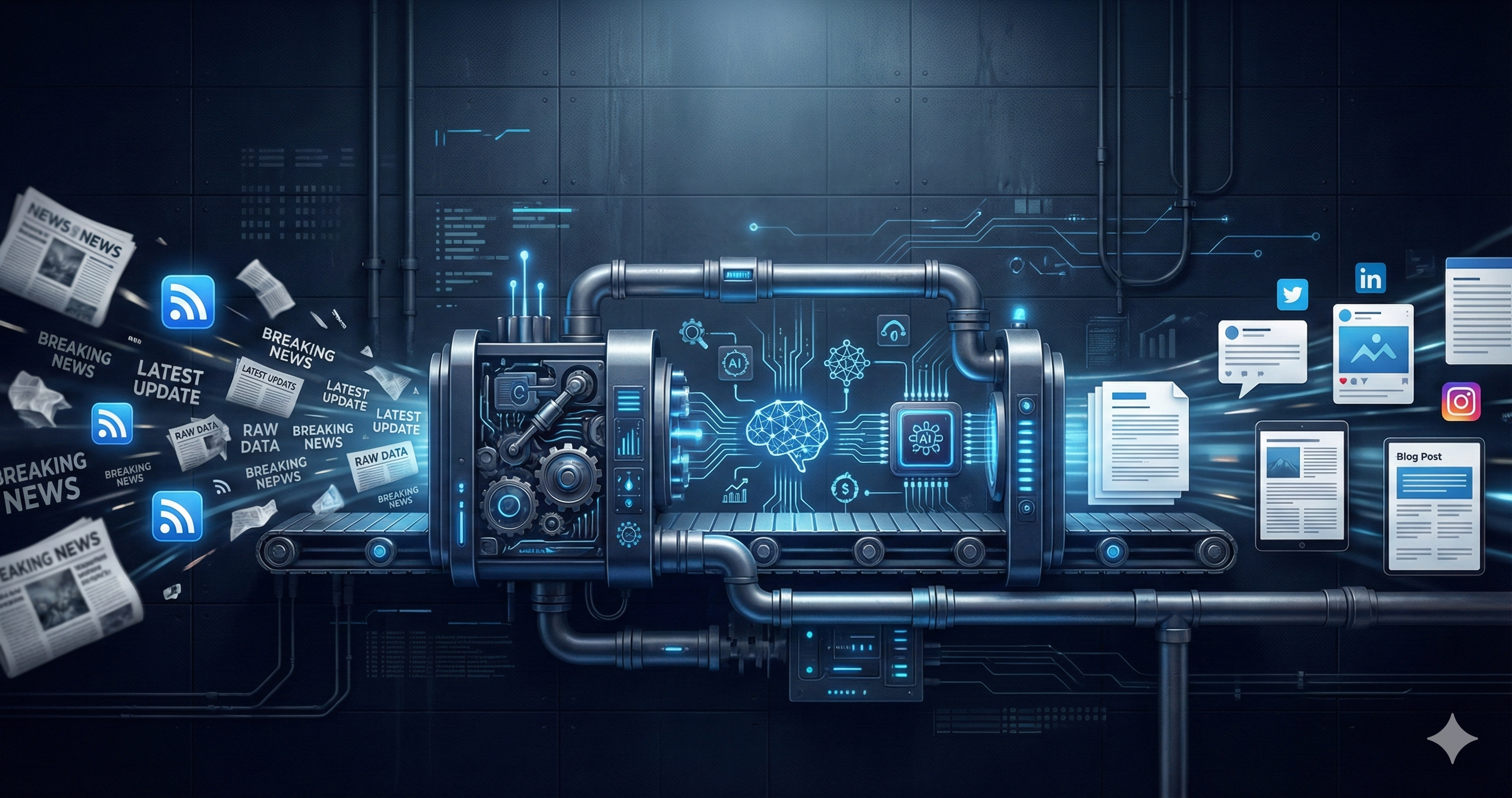
I employed AI combined with automated processes to produce first drafts of content that I (or my clients) can rapidly fine-tune into final products and send out for distribution.
I call it a Content Engine. And it’s changed everything.
How the Content Engine Works
I’m not going to give away all the secret sauce here (that’s what you hire me for), but I can walk you through the basic architecture:
1. Automated Collection
The engine continuously monitors news feeds and sources relevant to your beat, pulling in articles 24/7 without human intervention.
2. Intelligent Filtering
Raw feeds contain massive amounts of noise. The system automatically filters for your target keywords and topics, discarding everything else.
3. Similarity Clustering
When multiple sources cover the same story, the engine groups them together to create opportunities for more comprehensive, well-sourced content.
4. Full Content Extraction
The system scrapes complete articles (not just headlines) and merges related pieces into comprehensive research briefs.
5. Interactive Approval Workflow
You get real-time notifications with the research brief and can approve, decline, or request changes—all from your phone via Telegram.
6. AI Draft Generation
Once approved, the AI produces a publication-ready first draft based on your editorial guidelines and the merged source material.
7. Automated Distribution
Final approved content is queued directly to your social media management dashboard for scheduled publishing.
The entire cycle runs twice daily. While you’re sleeping, having coffee, or doing literally anything else, the engine is processing hundreds of articles, identifying content opportunities, and producing drafts.
What This Actually Means
Since building my first Content Engine, I haven’t missed a single content deadline. Not one.
More importantly: my clients haven’t either.
The creative work that used to exhaust me—gathering sources, synthesizing information, structuring narratives—now happens automatically. I spend my energy where it actually matters: making strategic decisions about what to publish and refining quality.
The writing that used to take me 4-6 hours per piece? Now takes 20 minutes to review and polish an AI-generated draft.
The content calendar that used to have embarrassing gaps? Now fills automatically, with room to spare for reactive content when news breaks.
Who Needs This?
If you’re in PR, reputation management, or any field where consistent content production is critical, you probably recognize this problem:
- You know what needs to be said
- You know how it should be positioned
- You even know when it needs to go out
- But somehow the content still doesn’t get produced on schedule
Or maybe you’re sitting on a content goldmine—dozens of ideas, a clear strategy, strong source material—but execution keeps stalling because writing is slow, tedious, and expensive.
That’s the problem a Content Engine solves.
It doesn’t replace human judgment. You’re still making the strategic decisions about what gets published and how it’s positioned. But it eliminates the mechanical friction that prevents good ideas from becoming published content.
The Bottom Line
I built this system to solve my own problem. Turns out, a lot of other people have the same problem.
If you’re tired of watching great ideas die in draft folders, or you’re spending money on content teams that can’t keep up with demand, or you’re just exhausted from the grind of daily content production—we should talk.
I build custom Content Engines for clients. Your beat, your editorial voice, your distribution channels. Fully automated, fully controllable, running 24/7.
Interested? Get in touch. Let’s talk about what a Content Engine could do for your operation.
Paul is a PR and communications strategist based in Manila who specializes in AI-enhanced content production systems. When he’s not building automation workflows, he’s trying to convince his four dogs that 5 AM is too early for breakfast.