But, Dear! Have You Been to the Philippines Though?
*”So long, and thanks for all the fish,”* I whispered to the concierge at my favorite Bangkok hotel last spring. The poor man looked puzzled—clearly not a Douglas Adams aficionado. But after your twentieth visit to the same gilded temples, you start feeling like a hitchhiker who’s forgotten their towel, no?
Let’s be honest, mi amigo. For those of us who’ve accumulated passport stamps like Hemingway collected war stories, the conversation about “traveling to Asia” follows a script so predictable you could set your Swiss watch to it. Tokyo stands precise as a haiku, Bangkok simmers in its familiar chaos, and Bali—well, Bali has become so Instagram-ordained that you half expect to find Elizabeth Gilbert’s spiritual guide selling smoothie bowls on Seminyak Beach.
They are, sans doute, magnificent in their way. But for the soul that yearns for a tale less told—a journey without the safety nets and tourist-board polish—these well-trodden paths have begun to feel like reading the same chapter of a book, expecting different words to appear.
Manila, by contrast, is where the real gonzo adventure begins. Not the manufactured kind with pre-arranged photo opportunities and air-conditioned discomfort, but the kind that makes Hunter S. Thompson’s Vegas escapades look like a corporate retreat. I’m talking about a city that doesn’t just present itself—it reveals itself, layer by layer, like a novel you can’t quite put down despite the late hour.
A Connoisseur’s Manila: Where the Sun Also Rises
After you’ve marveled at Japan’s clockwork precision—its trains arriving with atomic accuracy, its traditions standing like ancient sentinels—your discerning eye inevitably hungers for something rawer, doesn’t it? The Philippines offers what Hemingway might call “the true gen”—a landscape unvarnished, people unfettered.
Manila’s symphonic chaos—her jeepneys painted like fever dreams, her streets a testament to humanity’s beautiful struggle—presents a narrative that hasn’t been edited for mass consumption. One morning, I watched dawn break over Manila Bay from the historic Manila Hotel (where MacArthur once held court), the sky performing a color palette that would make even a jaded travel writer reach for metaphors. It wasn’t the clean-lined sunrise of Japan or the postcard-perfect dawn of Phuket—it was messy, vigorous, alive.
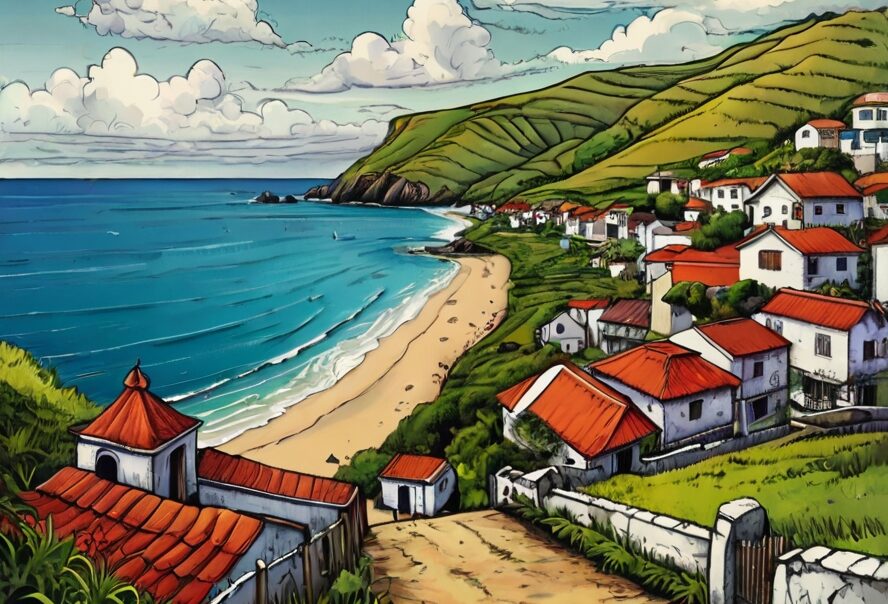
Beyond the city’s embrace, the archipelago unfolds like chapters in a magical realism novel. Consider the rice terraces of Banaue—crafted by hand when Rome was still young, they cascade down mountainsides with a precision that feels both ancient and immediate. Unlike Kyoto’s manicured gardens, there’s nothing performative here; it’s simply life, continuing as it has for millennia.
The Restaurant at the End of the Universe (Or At Least, Asia)
If Thailand’s tourism machine has left you feeling like just another consumer unit being processed through the gift shop of experience, the Philippines offers what Adams might call “the Ultimate Answer” (though it’s decidedly not 42).
Palawan—mon dieu!—presents beaches so pristine that describing them feels like cheapening the experience. Imagine stepping onto sand that has known few footprints, into water so clear it seems theoretical rather than physical. I once spent three days on a private cove near El Nido where my only companions were the shifting patterns of sunlight through palm fronds and a bartender who appeared, ghost-like, whenever my glass approached emptiness.
“The measure of intelligence is the ability to change,” Einstein supposedly said. For the traveler who has mastered the art of navigating Seoul’s digital wonderland or Singapore’s hyper-efficiency, the Philippines offers a different kind of intelligence test—one that rewards adaptability, curiosity, and what Hemingway called “grace under pressure.”
Fear and Loathing in Manila? Not Quite
Let me tell you about Filipino hospitality—not the rehearsed smiles of five-star chains, but the genuine warmth that makes you feel like you’ve returned to a home you never knew you had. It’s Thompson-esque in its intensity but without the pharmaceutical assistance.
I once found myself lost in Binondo, Manila’s ancient Chinatown, during a monsoon downpour. Before I could consult my useless map, an elderly shopkeeper ushered me inside, served sweet coffee, and insisted her grandson walk me back to my hotel—refusing payment with such vehemence that I felt ashamed for offering. “You are our guest,” she said simply, as if that explained everything. And perhaps it did.
The luxury here isn’t found in gold-plated bathroom fixtures or the perfect thread count (though both exist if that’s your particular fish). The true opulence lies in experiences that money alone cannot buy: a private tour of San Agustin Church with a Franciscan scholar who knows every secret the stones have witnessed; a helicopter journey at dawn to the perfect, empty beach; or dinner prepared by a chef whose grandmother’s recipes have never appeared in a glossy magazine.
Don’t Panic: Your Guide to Philippine Authenticity
For the traveler who has reached that peculiar state where Bangkok feels as familiar as Boston, Manila offers what might be the last true frontier of Southeast Asian discovery. It is, to borrow from Adams, “vastly, hugely, mind-bogglingly” different from what you’ve experienced before.
The Philippines doesn’t just present a different setting—it offers a fundamentally different story. One where the protagonist (that’s you, querido amigo) isn’t just passing through but becoming temporarily woven into the fabric of a place that defies easy categorization.
So yes, Tokyo will still stand immaculate. Bangkok will continue its eternal, beautiful hustle. But for those of us seeking the electric thrill of genuine discovery—that moment when you realize you’re experiencing something that can’t be adequately captured in a TripAdvisor review—Manila and her seven thousand sister islands await.
After all, as Hemingway might have observed had he ventured this far east: “The world breaks everyone, and afterward, many are strong at the broken places.” Perhaps what we’re really seeking isn’t perfection, but authenticity—those beautiful broken places where real life happens, unscripted and magnificent.
Shall we explore them together?